
Let me tell you something I’ve seen hundreds of times in my 6+ years working with companies across Europe and Morocco: 73% of websites have critical SEO issues they don’t even know exist. It’s like driving with the parking brake on and wondering why you’re not moving forward.
Last week, a client contacted me frustrated because they’d been “doing SEO” for months without results. Within 48 hours of auditing, we discovered Google couldn’t even properly index their site. Imagine investing thousands of euros in content that simply doesn’t exist for search engines.
An initial SEO audit isn’t just an automated checklist. It’s the professional diagnosis that tells you exactly where you are, why you’re there, and how to get where you want to be. And trust me, after optimizing sites that have reached over 500,000 monthly visits, I know what I’m talking about.
Table of Contents

What Is an Initial SEO Audit, Really?
Think of your website as a building. You can have the best offices, the most beautiful design, and incredible products, but if the foundations are cracked or the address on Google Maps is wrong, no one will ever arrive.
An initial SEO audit is that complete structural examination before investing in expensive renovations. It’s the difference between spending money hoping for results and strategically investing knowing exactly what return you’ll get.
Initial Audit vs. Ongoing Audit: Which Do You Need?
The initial audit is your starting point. You do it when:
- You’ve just launched a new site
- You’ve noticed unexplained traffic drops
- You’re about to redesign your website (please, before, not after)
- You’ve never done professional SEO and want to start right
- You’re changing niches or business strategy
The ongoing audit is maintenance. I do it with my clients quarterly once they’re already optimized and scaling.
If you’re reading this, you probably need the initial one. And here I’m going to show you exactly what I include in the audits I perform for companies like TotalEnergies, Glovo, and dozens of businesses that have multiplied their organic visibility.

The 5 Pillars of a Professional SEO Audit
At One Prose, we don’t do superficial audits. I use a methodology I’ve perfected working in markets as competitive as Spain, France, and Morocco, combining premium tools with expertise that only comes from real experience.
1. Complete Technical Analysis: The Invisible Foundations
This is where I separate amateur audits from professional ones. Technical SEO is invisible to your visitors, but it’s the first thing Google sees.
What I analyze in depth:
Speed and Core Web Vitals: I use Screaming Frog and Google PageSpeed Insights to measure every millisecond. Did you know that one extra second of load time can reduce conversions by 7%? I’ve optimized sites that went from 8 seconds to 1.2 seconds. The impact on rankings is immediate.
Indexability and Crawling: I review your robots.txt file line by line, analyze your XML sitemap, and verify that Google can access all important pages. I’ve found sites where 60% of content was accidentally blocked. Money thrown away.
Site Architecture: Your URL structure should be logical, both for users and bots. I evaluate click depth (no important page should be more than 3 clicks from home), category hierarchy, and internal authority distribution.
Mobile-First: In 2026, if your site isn’t flawless on mobile, you simply don’t exist. Google indexes the mobile version first. Period. I use tools like BrowserStack to test on 20+ real devices.
Critical Errors: I scan every corner looking for 404 errors, redirect chains (each redirect loses authority), broken internal and external links, and canonicalization issues. I once found 847 404 errors on a “well-maintained” site.
Schema Markup: Structured data is your competitive advantage for rich snippets. I implement schema for products, articles, FAQs, organizations, events… whatever your business needs to stand out in results.
2. Keyword Research: Speaking Your Customers’ Language
Many businesses target the wrong keywords. They optimize for terms that are either impossibly competitive or that no one actually searches for.
My keyword research process includes:
Current Keyword Analysis: First I need to know what you rank for now. I use SEMrush and Ahrefs to extract every keyword you receive impressions for. I often find that a site ranks for hundreds of irrelevant terms while ignoring gold mine opportunities.
Search Intent Research: Not all keywords are equal. “Buy running shoes” has transactional intent. “How to choose running shoes” is informational. I map each keyword to the correct stage of the customer journey.
Long-Tail Opportunities: These are my favorites. Less competition, more conversion. Instead of fighting for “digital marketing” (impossible without massive budget), we attack “digital marketing agency Tangier for exporters” (specific, achievable, converting).
Cannibalization Analysis: Do you have 5 pages competing for the same keyword? Google gets confused and none rank well. I identify these conflicts and create a consolidation or differentiation strategy.
Gap Analysis: This is pure competitive intelligence. I find valuable keywords you should rank for based on your authority and niche, but currently don’t. It’s like finding 50-euro bills in the couch.
3. Competitive Analysis: Know the Battlefield
If you don’t know who you’re really competing against on Google, you’re fighting blind.
Identifying Real SEO Competitors: Your business competitors aren’t always your SEO competitors. I use tools to identify who’s actually stealing clicks from you on the terms that matter.
Authority Benchmarking: I compare your Domain Authority, Trust Flow, and backlink profile against the top 3 competitors. This tells me if you’re in the same league or need a different strategy.
Content Strategy Reverse Engineering: I analyze what type of content works in your niche. Long guides? Videos? Infographics? Lists? Case studies? I don’t guess, I analyze real data of what ranks in position 1-3.
Backlink Gap Analysis: I identify sites that link to your competitors but not to you. These are low-effort, high-impact link building opportunities.
Content Opportunities: I find topics your competitors are ignoring or covering superficially. That’s where you can dominate quickly.
4. On-Page Audit: Page-by-Page Optimization
Content is king, but a poorly dressed king doesn’t impress anyone.
Meta Titles and Descriptions: Every page should have unique, descriptive titles with primary keywords at the beginning, and within 60 characters. Meta descriptions should sell the click in 155 characters. I review 100% of your important pages.
Heading Structure: One H1 per page (with primary keyword), H2s that divide content logically, H3s for subsections. It’s basic SEO but 80% of sites get it wrong.
Image Optimization: Heavy images kill speed. I analyze sizes, formats (WebP is the standard now), compression, and descriptive alt text on every image. I’ve reduced site weight by 70% just optimizing images.
Duplicate Content: Both internal and external. Google heavily penalizes copied content. I use specialized tools to detect even subtle partial duplications.
Internal Linking: Your internal link architecture distributes authority and guides users. I identify orphan pages (without incoming links), contextual linking opportunities, and optimal anchor texts.
5. Off-Page Analysis: Your Digital Reputation
Backlinks remain one of the top 3 ranking factors. But quality over quantity, always.
Current Backlink Profile: I extract and analyze every link pointing to your site. Where do they come from? Are they relevant? Are they dofollow or nofollow? From what anchor texts?
Quality vs. Quantity: A link from The Guardian or TechCrunch is worth more than 1,000 links from junk directories. I evaluate quality using metrics like Domain Rating, organic traffic of the referring site, and topical relevance.
Toxic Link Detection: Links from spam sites, link farms, or PBN networks can lead to a manual penalty from Google. I identify these links and create a disavow file if necessary.
Anchor Text Analysis: A natural distribution includes brand, naked URLs, generics (“click here”), and exact match keywords. A profile with 90% exact match anchor text screams “manipulation” to Google.
Brand Mentions: I find places where they mention your brand or products without linking to you. These are easy opportunities to get backlinks by contacting the author.

The Real Benefits of a Professional SEO Audit
Let me be direct: an audit doesn’t increase your traffic. It’s the diagnosis. What you do afterward increases your traffic.
But without the correct diagnosis, you’re spending money on solutions for problems you don’t have, ignoring the real problems that are costing you thousands of monthly visitors.
Immediate Benefits (Month 1-2)
Complete Visibility of Your Current Situation: You’ll know exactly your Domain Authority, what keywords you rank for, how many backlinks you have, what technical problems exist, and how you compare to competition. Zero guessing. Just data.
Quick Win Detection: I always find problems that can be fixed in hours and give results in weeks. One client had all their pages blocked in robots.txt except the homepage. We fixed it in 10 minutes. Traffic went up 340% in 3 weeks.
Disaster Prevention: I’ve saved clients from redesigns that would have destroyed all their SEO. Poorly done migrations can erase years of work in one day. The audit identifies these risks before it’s too late.
Medium-Term Benefits (Month 3-6)
Optimized Marketing ROI: When you know your problem is thin content, you don’t spend on link building. When you know your problem is low authority, you don’t spend on more content yet. You invest where you really need to.
Documented Competitive Advantage: Knowing your competitors’ weaknesses gives you an exact map of where to attack. I’ve won entire markets for clients simply by doing well what the competition was ignoring.
Data-Driven Strategy: No more “I think we should do X.” Everything is “the data shows that if we do X, we’ll get Y, because we’ve seen that Z works in your niche.”
Long-Term Benefits (Month 6-12+)
Solid Foundations to Scale: A site with a solid technical base can grow 10x without problems. A site with a weak base collapses when you grow. I’ve seen sites crash from their own success because they never fixed the foundations.
Immunity to Algorithm Updates: Google makes 500+ changes a year. Sites with solid, white-hat SEO barely flinch. Sites with tricks and shortcuts collapse. The audit identifies risks of future penalties.
Sustainable Organic Growth: Paid traffic stops when you stop paying. SEO done right is an asset that appreciates over time. I have clients from 2019 who are still receiving results from work we did back then.

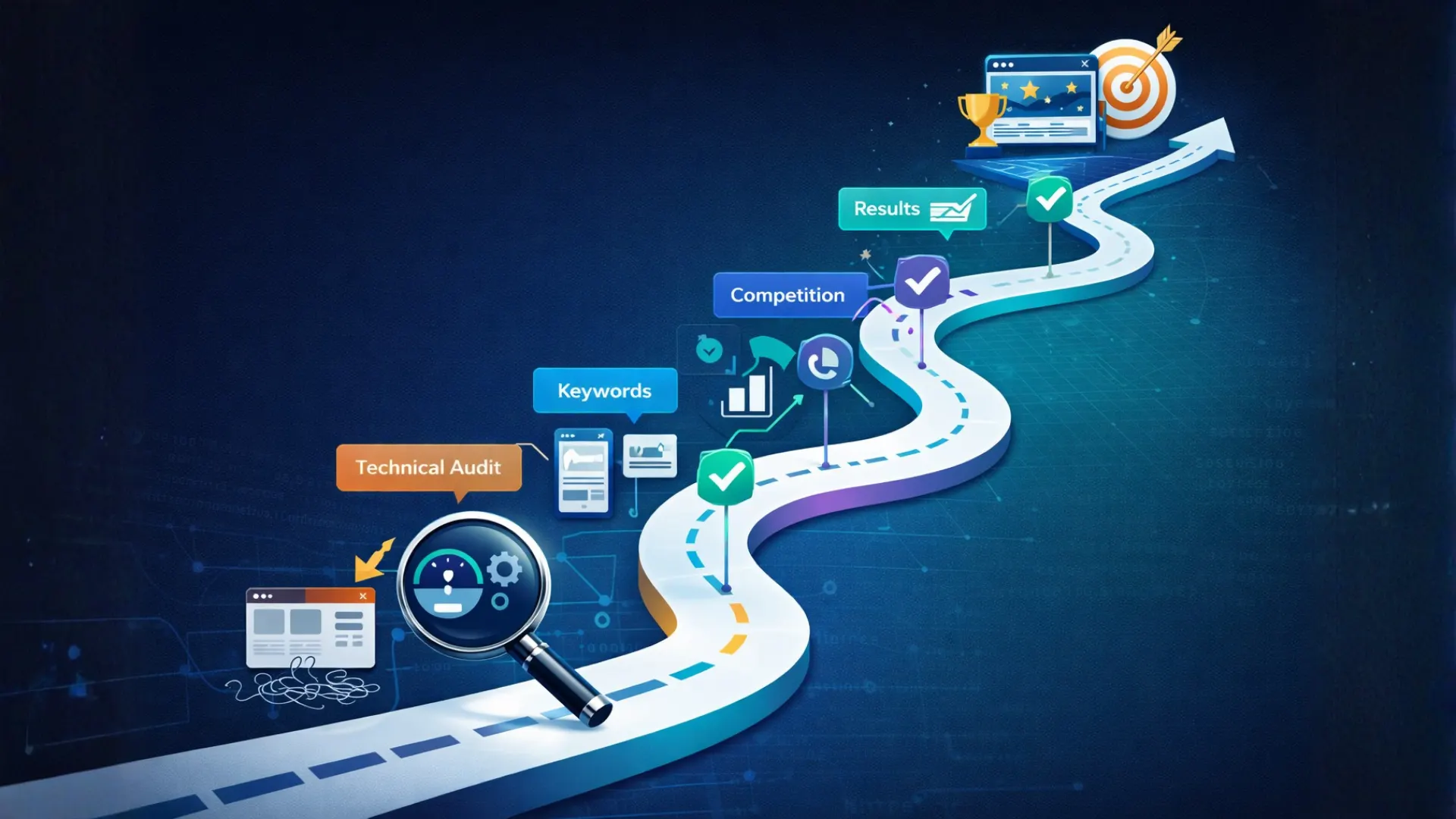
My Audit Process: 6 Steps Toward Clarity
At One Prose, every audit follows a process I’ve perfected after hundreds of projects.
Step 1: Collection and Access (Day 1) I need access to Google Analytics, Google Search Console, and your CMS. Also any previous advertising campaigns, past audits, or relevant data you have.
Step 2: Crawling and Automated Analysis (Days 2-3) I use Screaming Frog to scan your entire site, SEMrush for keywords and competition, Ahrefs for backlinks, and proprietary tools I’ve developed for specific analyses. This gives me a mountain of raw data.
Step 3: Expert Manual Analysis (Days 4-5) This is where my experience matters. I manually review key pages, analyze content quality, evaluate UX from an SEO perspective, and find patterns that tools don’t detect. Automation is powerful, but an expert human eye is irreplaceable.
Step 4: Market and Competition Analysis (Day 6) I study your top 3-5 SEO competitors in depth. Reverse engineering their strategies, identifying their strengths and weaknesses, and mapping opportunities.
Step 5: Findings Compilation (Days 7-8) I organize all the data into an understandable report. I don’t want to overwhelm you with 300 pages of technicalities. I want you to clearly understand what’s right, what’s wrong, and why it matters for your business.
Step 6: Prioritized Action Plan (Days 9-10) This is the most valuable part. A clear roadmap, prioritized by impact vs. effort, with realistic timelines, necessary resources, and KPIs to measure success.
Bonus: Live Presentation (Included) 30-60 minutes with me where we review the main findings, I resolve your doubts, and we adjust the plan according to your capabilities and business priorities.

The Action Plan: From Insights to Results
A report without an action plan is entertainment. Interesting, but useless.
My action plan includes three priority levels:
Quick Wins (Implement in 2-4 weeks)
Critical technical problems, obvious errors, low-effort, high-impact opportunities. Things like:
- Fix 404 errors on important pages
- Correct duplicate metas
- Optimize basic speed
- Implement simple schema markup
- Claim brand mentions without links
Expected impact: 15-30% improvement in impressions in 4-6 weeks.
Medium-Term Actions (1-3 months)
Substantial improvements that require more work but give solid results:
- Create content for identified keyword gaps
- Improve top 10 pages to move them to top 3
- Targeted link building campaign
- Deep optimization of key pages
- Site architecture restructuring
Expected impact: 40-80% improvement in organic traffic in 3-4 months.
Long-Term Strategy (3-12 months)
The background work that builds real authority:
- Pillar content and hub strategy
- Sustained link building
- Expansion to new markets/keywords
- Continuous performance-based optimization
- Brand and authority building
Expected impact: 2-5x increase in organic traffic in 12 months.
Each action comes with:
- Clear description of exactly what to do
- Necessary resources (time, budget, tools)
- Ideal responsible party (you can do it, you need a freelancer, or you need an agency)
- Specific KPIs to measure success
- Realistic timeline based on my experience
Real Case: From 2,000 to 47,000 Monthly Visits
Let me share a case I’m especially proud of.
Client: Eco-friendly products e-commerce (Barcelona) Initial situation: 2,100 organic visits/month, Domain Authority 18, selling mainly via Facebook Ads with tight margins.
Problems detected in audit:
- 60% of site not indexable due to incorrect robots.txt configuration
- 6.8 seconds load speed on mobile (products with 10+ unoptimized images)
- Zero keyword strategy – they were attacking impossible generic terms
- Product content copied from manufacturer (duplicated on 50+ sites)
- Confusing category structure even for humans
- Only 12 backlinks, several toxic
Action plan implemented:
Month 1: Technical quick wins – we fixed indexation, optimized images (73% weight reduction), corrected URL structure.
Result: 4,800 visits/month (+128%)
Month 2-4: Rewriting 80 product pages with unique and optimized content, creation of 15 long-tail buying guides, product schema implementation, initial link building campaign securing 8 quality links.
Result month 4: 14,200 visits/month (+576% vs. start)
Month 5-12: Content expansion to blog with 40 informational articles, sustained link building (2-3 quality links/month), continuous optimization based on Search Console data.
Result month 12: 47,300 organic visits/month (+2,152% vs. start)
Business impact: They reduced Facebook Ads dependency by 65%, increased organic sales 340%, and most importantly – acquired customers with 2.3x higher LTV than paid ads customers.
Was it easy? No. Was it fast? Neither. Was every euro invested worth it? Absolutely.
And it all started with an audit that revealed exactly where they were and what they needed to do.
The Tools Behind the Magic
Technology without expertise is noise. Expertise without tools is slow and incomplete. I combine both.
My technical arsenal includes:
- Screaming Frog SEO Spider: For exhaustive crawling and technical problem detection
- SEMrush: Keyword research, competition analysis, technical audit
- Ahrefs: Backlink analysis, keyword research, top content
- Google Search Console: Direct data from Google about your performance
- Google Analytics 4: User behavior, conversions, key data
- PageSpeed Insights & GTmetrix: Performance and Core Web Vitals
- Surfer SEO: On-page optimization based on top rankers
- Answer The Public & AlsoAsked: Search intent research
But here’s the secret: these tools tell everyone the same thing. The difference is in how you interpret that data and what you do with it.
I’ve seen people with access to the same premium tools draw completely wrong conclusions because they don’t understand the context, the industry, or the nuances of Google’s algorithms.
My value isn’t in having the tools. It’s in my 6+ years interpreting them in competitive markets, in 4 languages, in dozens of different industries.
Questions I Always Get Asked
How long does a complete SEO audit take?
A serious and exhaustive audit takes me 10-12 working days. These aren’t consecutive days – it can be distributed over 2-3 calendar weeks depending on your site size and industry complexity.
The automated “audits” that give you results in 5 minutes are basically tool reports without real analysis. Useful for a quick overview, but not for making serious investment decisions.
How often should I do an audit?
Complete initial audit: Once if you’ve never done it, or when you radically change your site/strategy.
Maintenance audits: Every 6-12 months for stable sites.
Focused audits: Every 3 months on specific areas (content, technical, backlinks)
Google makes ~500 algorithm changes a year. Your competition doesn’t sleep. Your site accumulates problems over time. SEO isn’t “set and forget.”
Can I implement the plan myself or do I need help?
It totally depends on your technical capacity and available time.
You can do it yourself if:
You have basic HTML/CSS knowledge
You understand fundamental SEO concepts
You have available time (10-20 hours/week)
Your site is relatively simple (standard WordPress, for example)
You need professional help if:
The problems are technically complex (JavaScript rendering, CDN issues, etc.)
You need fast and accurate results
Your time is worth more than the cost of outsourcing
You want to avoid costly mistakes
My action plan specifies what’s DIY-friendly and what requires experts. I’m transparent about this because I want you to succeed, not get frustrated trying things beyond your reach.
What’s the difference between a free audit vs. professional one?
Free audits are marketing tools (I myself offer a basic one). They give you a general idea, identify superficial problems, and motivate you to act.
A professional audit is:
10-20x deeper: Analyzes hundreds of factors vs. 20-30
Contextualized: Considers your industry, market, specific competition
Actionable: Detailed plan vs. generic “you should do X” list
With human expertise: Expert interpretation vs. automated output
Personalized: Adapted to your resources and objectives vs. standard recommendations
Think of it as the difference between a YouTube video about “how to lose weight”
Does the SEO audit guarantee results?
Let’s be clear: the audit is the diagnosis. It guarantees you’ll know exactly what’s wrong and how to fix it.
Results come from implementing the recommendations correctly and sustainably.
That said, based on my experience:
95% of sites see measurable improvements in 2-3 months implementing quick wins
100% of clients who implement the complete plan see positive ROI in 6-12 months
0% of clients who only read the audit without acting see results
SEO isn’t a lottery. It’s consistent work based on solid fundamentals. The audit gives you those fundamentals. You (or your team/agency) execute them.
Your Smartest Decision of 2026
Look, you can keep doing SEO “let’s see what happens.” Publishing content without strategy. Hoping Google finds you. Watching your competitors pass you by.
Or you can make an informed decision based on real data about your site.
I’ve worked with startups that became market leaders. With traditional businesses that digitized their sales. With e-commerces that went from depending 100% on paid ads to generating 60% of revenue organically.
They all started the same way: with an audit that showed them the truth, no filters, no excuses.
The difference between a site that grows and one that stagnates isn’t budget, isn’t luck. It’s knowledge. Knowing exactly what to do and in what order.
Start Today
A professional SEO audit is the best ROI investment you can make in your digital presence. Period.
It’s not an expense. It’s clarity. It’s strategy. It’s the map that gets you out of being lost in the woods.
If you’re ready to stop guessing and start knowing, let’s talk.
I include a 60-minute strategic session where we review the main findings together and adjust the plan to your specific reality. Because an audit is only worth it if you understand it and can act based on it.
📧 Contact me directly: info@oneprose.ma 🌐 Schedule a discovery call: here
The next 6 months on Google are decided today. Are you navigating blind or with a map?